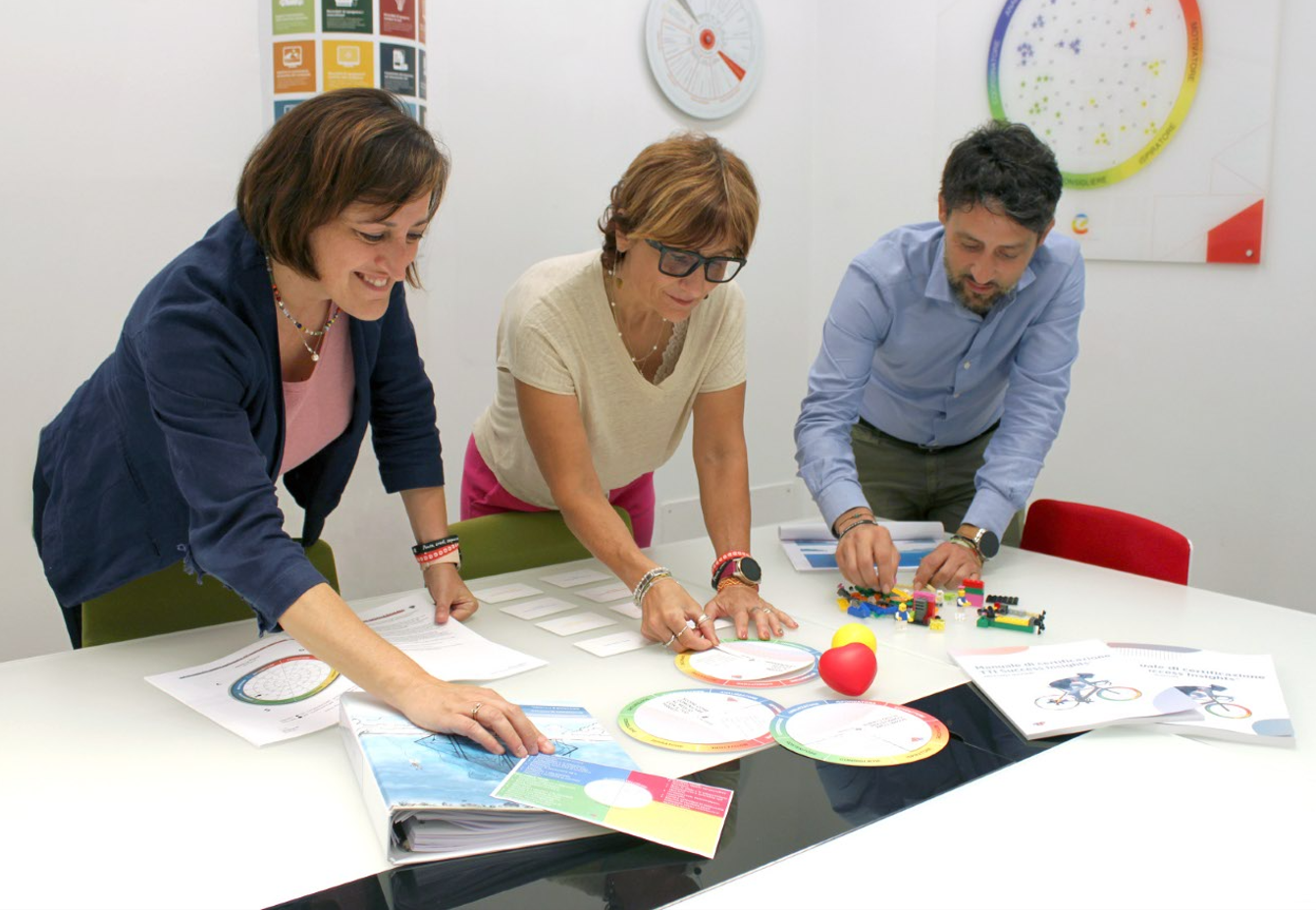
At e.group, we believe that professional growth begins with self-awareness: understanding who we are, recognizing our talents, and gaining insight into how we relate to others and what truly motivates us. With this mindset, we introduced the TTI Success Insights method—an internationally recognized tool that helps us unlock people’s potential and enhance performance in a sustainable way.
Its foundations trace back to the history of human thought—from Empedocles and Hippocrates to Carl Gustav Jung, Jolande Jacobi, and William Moulton Marston. Building on these ideas, in the 1980s Bill Bonnstetter developed the TTI Success Insights wheel, an evolution of the DISC model, expanding it into eight behavioral styles and 60 positions that describe both natural behavior and how it adapts to different situations.
Alongside behavioral analysis, the method also incorporates the 12 Driving Forces, inspired by the work of Edward Spranger and Gordon Allport, which explore what drives and fuels our decisions. In the following decade, further research led to the development of EQ analysis, based on Daniel Goleman’s five dimensions of emotional intelligence: self-awareness, self-regulation, motivation, empathy, and social skills.
The result is a comprehensive model that offers a deep and holistic view of the individual, combining how we act, why we act, and the emotional energy that sustains us.
The Cyclist Metaphor: A New Perspective on Performance
To explain the model’s dynamics, TTI Success Insights uses the image of a cyclist:
the front wheel represents observable behaviors—how we approach tasks;
the rear wheel, which drives motion, symbolizes motivational forces—the why behind our actions;
emotions act as the core energy that allows us to move forward with direction and intensity.
When these elements are aligned, individuals can fully express their true potential.
A Method Serving People and the Organization
The introduction of the TTI Success Insights method at e.group has brought tangible value to HR processes, particularly in recruitment, development, and role transitions—especially for positions that involve coordinating teams and complex projects.
The goal is to foster greater individual and collective awareness, improve communication, and build more cohesive teams. The analysis highlights strengths, areas for improvement, and natural inclinations, helping each person find the role where they can perform at their best.
This approach not only supports professional growth but also nurtures a more open, inclusive, and positive work environment.

Daniela
Head of Human Resource